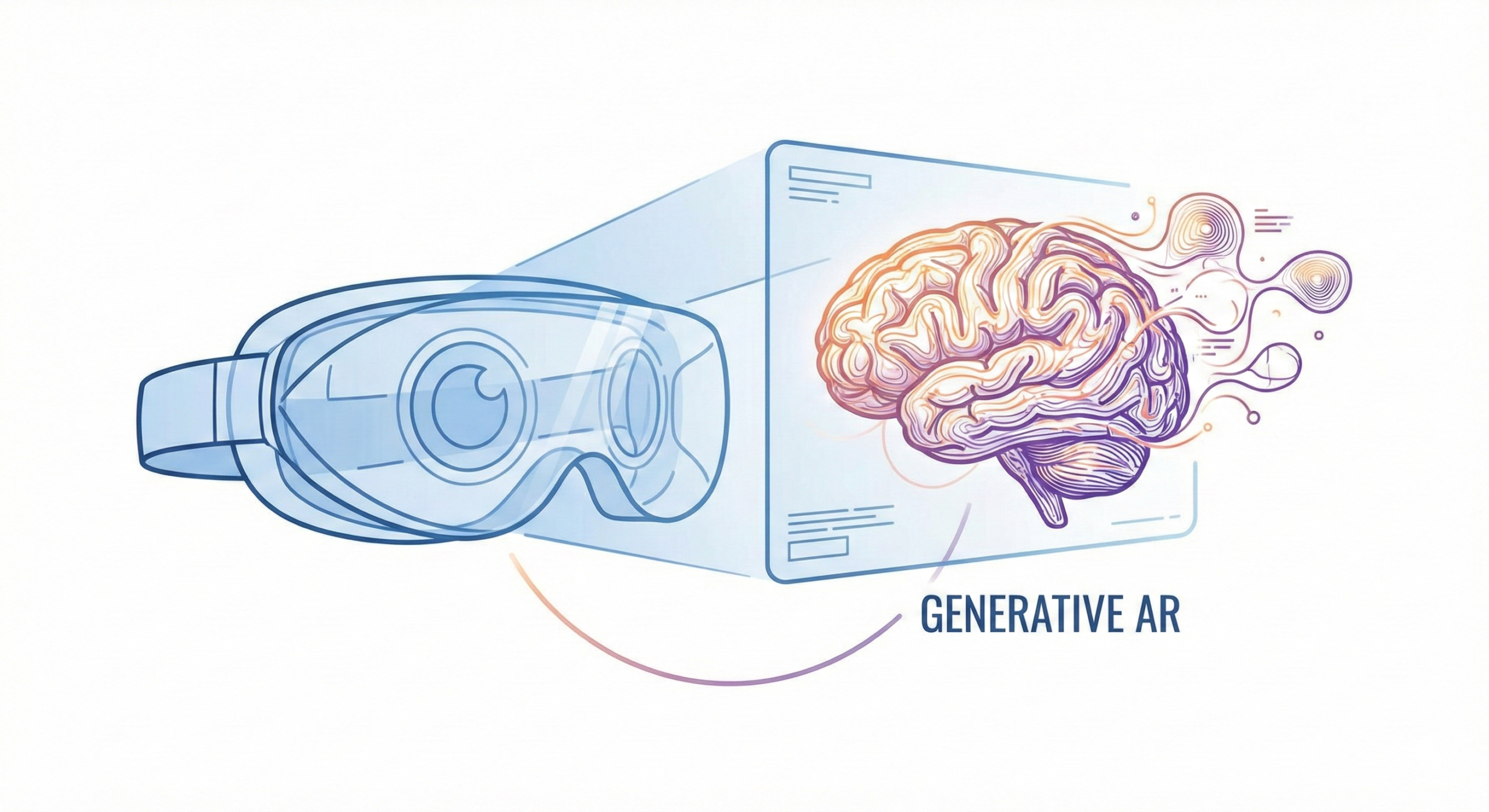

Imagine having the ability to transform the reality around you in real time, powered 100% by artificial intelligence. In the niche of immersive technology, we know that creating a visual impact is vital. Combining generative AI with augmented reality is what I call Generative Augmented Reality (GAR)
The convergence between Artificial Intelligence (AI) and Augmented Reality (AR) is proving to be the true future of the industry. We know this technological leap as Real-Time Transformation. That technical name may not excite the public, but it encompasses a great deal of revolution.
To understand where we are headed, we must first remember our origins.
What is augmented reality?
In 1997, Ronald Azuma laid the foundations for classic augmented reality by defining three fundamental requirements that this technology must meet:
- Combine the real with the virtual,
- Enable real-time interaction, and
- Have a 3D anchor or registration.
Generative Augmented Reality takes these pillars and revolutionizes them. It is no longer just a matter of superimposing pre-rendered elements; it is a system that learns, projects, and generates a new reality dynamically.
What is Generative Augmented reality?
Generative Augmented Reality (GenAR) is the technology that merges reality with the virtual in real time, using Artificial Intelligence models to generate and adapt digital content in a contextual and dynamic way.
Clash of Two Worlds: Classic AR vs. Generative AR
As we interact with these new tools, questions arise about which methodology is superior.
Control: On traditional platforms such as Lens Studio, the creator has complete control over the result. If a brand requires an exact color or a logo positioned with millimeter precision, it can be programmed. Generative AR, on the other hand, works like a “black box” where the result, although impressive, can vary with each interaction.
The Experience: Classic AR excels in interactivity, allowing for the programming of collisions, physical buttons, and specific logic, etc. Currently, pure AI tools are predominantly visual and do not (yet) support complex direct interaction logic.
Realism: This is where Generative Augmented Reality makes a huge difference. Achieving perfect lighting, shadows, and occlusions in classic AR requires hours of technical hard work. Generative artificial intelligence, on the other hand, “hallucinates” the perfect light, understands the behavior of materials, and adapts the perspective in a matter of seconds.
Development: Generative augmented reality is a technology in its infancy. We don’t program in the traditional sense, but rather interact through prompts and images, although APIs are already beginning to democratize access.
The Immediate Revolution: E-commerce and Virtual Fitting Rooms
One of the most powerful use cases with the greatest conversion potential for businesses is virtual fitting rooms. Using beta platforms such as Lucy 2.0, it is possible to import a simple image from a clothing catalog (e.g., Adidas) and, using a prompt, have the user try on the garment in real time.
The level of detail is so high that the AI understands the user’s movement and makes the fabric adhere and respond to the physics of the body in a surprisingly natural way, even using a low-resolution webcam. Whether trying on an urban outfit or an elegant tuxedo, the level of realism opens the door to optimizing the online shopping experience.
Platforms leading the niche
The ecosystem is growing rapidly, and key tools are already available to start experimenting in this laboratory of the future:
Krea: A pioneering real-time generation platform that allows experimentation with segmentation, isolating generative effects on specific parts of the body, such as the hand. Web Krea
Decart (Lucy 2.0): Currently in open beta, it stands out for its unmatched quality in transforming objects and people, making it the ideal option for prototyping e-commerce experiences. Web Lucy 2.0
XMAX AI: A recent tool (currently in closed beta) that includes features such as “Dim X,” allowing AI-generated characters to be added to the physical environment, similar to a World Tracker, with which you can interact live. Web XMAX
Generative Augmented Reality is not coming to immediately replace classic AR, but rather to radically expand its horizons. Experimenting today with the fusion of AI and AR is to secure a place at the forefront of tomorrow’s digital communication. Now is the time to try, make mistakes, and discover the new rules of immersion.


Deja un comentario